
SHELF III · CAMERA
“Past twenty seconds my stars turn into little dashes and I do not know how to stop it.”
Tracking Mounts and Polar Alignment
Star trackers and equatorial mounts set up properly: balance, polar alignment by scope and by software, guiding when it is worth it, and how to tell whether trailing comes from the mount, the wind or the focus.
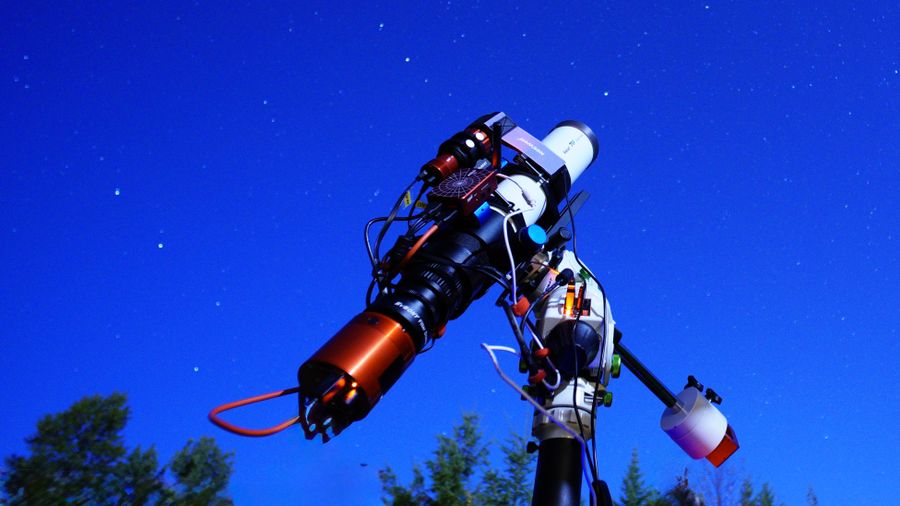
What you will be able to do
- Balance and polar-align a tracker or equatorial mount
- Take round-star exposures of several minutes
- Work out why stars trail and fix the right thing
Night log: the units
- UNIT 01 Why the sky moves and how a mount follows it
- UNIT 02 Star trackers for cameras
- UNIT 03 Equatorial mounts and balance
- UNIT 04 Polar alignment, three ways
- UNIT 05 Guiding: when and how
- UNIT 06 Diagnosing trailed stars
What is included
- A portable star tracker and a full equatorial mount set up from the case on screen
- Balancing in both axes, demonstrated slowly
- Polar alignment with a polar scope and with plate-solving software
- Diagnosing trailed stars: mount, wind, flexure or focus
- 18 months of streaming access
Who it suits
Photographers moving from a fixed tripod to tracked exposures, and telescope owners with an equatorial mount.
Questions about this course
What do I need before I start?
Phone or camera + tripod, Tracking mount. Nothing has to be bought in advance: the course opens with what to choose and why.
How long will it take me?
There are 42 lessons, 8 h 24 min of video in all. At about 3 hours a week that is roughly 3 weeks, but the pace is yours: clear nights decide more than the calendar.
How long can I watch it, and is there a tutor?
You can stream every lesson for 18 months from when access starts. The lessons are recorded: there is no live tutor and no marking, and the videos cannot be downloaded.
Pairs well with
-
-
SHELF IV · ROUTE
The Imaging Route: Tripod to Deep Sky